
The smell of flowering clover, the rustle of the fields and the tiny, unobtrusive movement - thousands of tiny wings, without which the harvest would make no sense and maybe even wouldn't exist. Bees, quiet, hard-working creatures that we may not normally notice, but are essential to our fields.
In Sanagra we have been beekeeping for several years. We started at Bospor Agro -Husky, where our first hives and first experiences were made. Today, the whole project is developing mainly in Sobotisti - it has found a base here in the form of a caring team and the support of people who perceive the real importance of this craft. The main reason? To support the harvest naturally - through pollination.🍯
Without pollination there would be nothing to reap
Bees are much more than just a source of honey. According to the United Nations, about 1/3 of the world's food production depends on pollination provided by bees and other insects. Without their presence, many crops would simply not produce a harvest.
However, pollination affects not only the quantity but also the quality and viability of the crop itself. It makes the fruit larger, more uniform and more durable. This is why beekeeping has become a natural part of our colleagues from Sobotišť's approach to the land, the landscape and the overall philosophy of organic farming.
Behind every hive there is a beekeeper (or beekeepers) 😊)
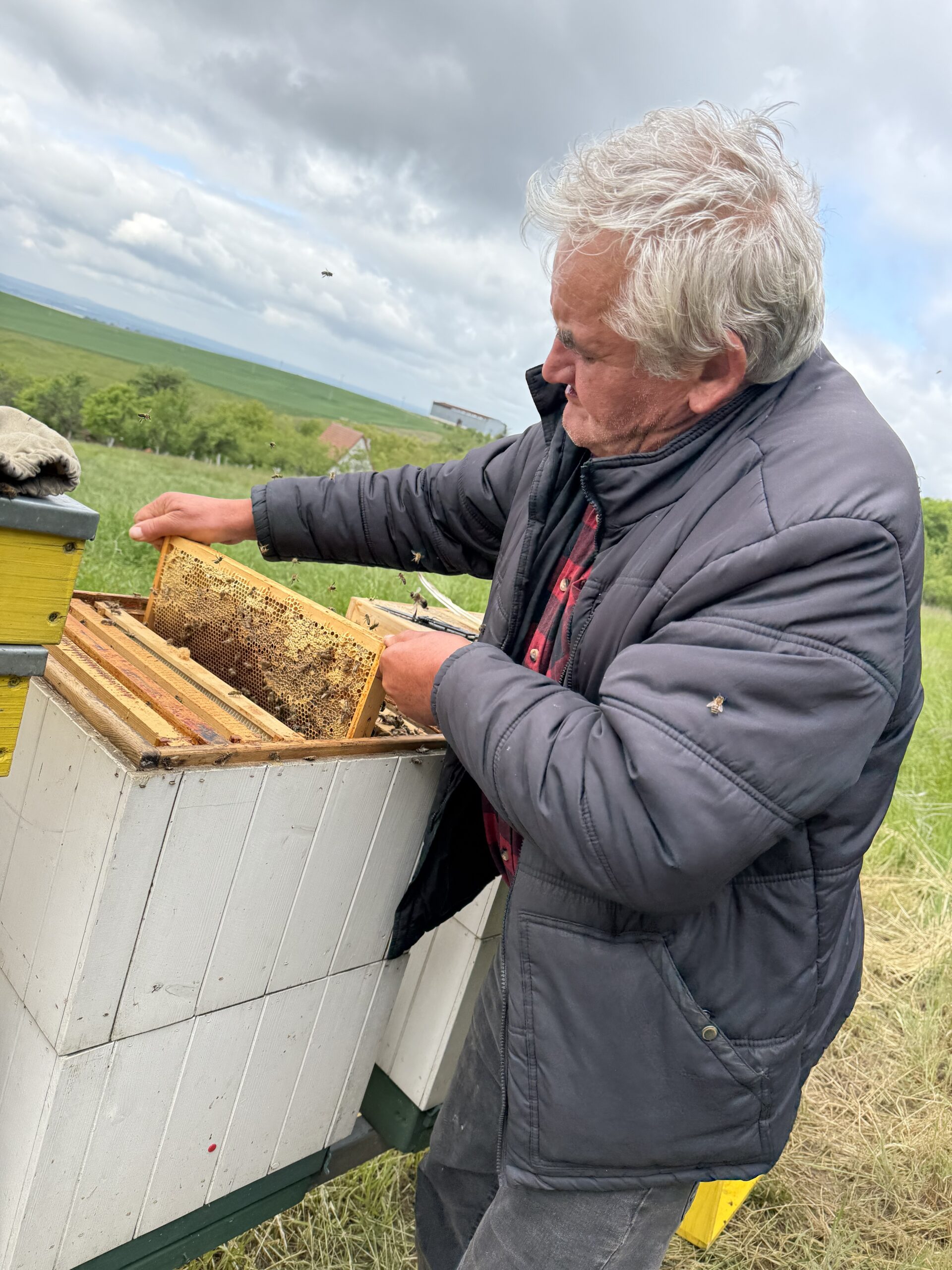
Two experienced gentlemen - Miroslav Liška with more than 40 years of experience and Pavol Straka, his skilful successor, take care of our sanagrakes on a daily basis. Together they form a close-knit team that really understands bees and treats them with respect, patience and a feeling for their natural rhythm. They follow their needs, their cycles and their moods - and are able to create conditions in which the bees thrive. It's not just a craft, but a relationship - with nature, the harvest and beekeeping itself.
Bees + beekeeper = fertilization team
Literally. That's why we decided to interview our gentlemen beekeepers who not only understand life in the hive, but also devote their time and attention to it every day. In the following posts, they'll tell us how bees work, what they can do, and why each hive is like a small, well-tuned microcosm. We asked Miroslav Líška and Pavel Straka.
When people say "life in the hive", what is the first thing that comes to your mind as a beekeeper?
ML+PS: Silence, order and system. Everything has its place and time in the hive - nothing is random there. Every bee knows what to do, even without being told. It's like a small, perfectly organized world where everything happens according to nature, not according to man. If one learns to just observe there and not interfere more than necessary, one learns a lot about oneself as well.
How many hives are you currently working with?
ML+PS: We are currently looking after about 50 colonies, having started with 32. We are gradually expanding them as conditions and the season allow.
Who all inhabits the hive within the beekeeping practice and what is their number?
ML+PS: In one strong hive there can be 50 to 60 thousand bees. In addition, there is one queen who lays the eggs. The rest are workers who do everything from cleaning to guarding to flying around in search of nectar. And then there are the drones - they only appear in season and their only job is to fertilize the young queen. Interestingly, all these bees don't have the same lifespan. In fact, we are talking about the so-called summer and winter bees. Summer bees live for only 4 to 6 weeks - they work very hard and wear out quickly. Winter bees start their life at the end of the summer, they don't fly and save energy - that's why they can survive for up to 6 months. They have more fat reserves and their job is to keep the hive warm, feed the queen and live to see spring when a new cycle of life begins.
How are the bees organised?
ML+PS: Yes - each bee goes through different roles during its lifetime, which change according to its age. At first, it stays inside the hive for a few days: cleaning cells, feeding the larvae, caring for the queen and processing nectar. Later, she may become the hive's guardian. Only when she reaches a certain age does she start to fly out. At first she just flies around and orients herself in the field, then she becomes a forager, a bee - which carries nectar and pollen. This is the last stage of its life. From the moment she starts flying, she is at higher risk. Her wings, body and nervous system are worn out. At this stage, she no longer takes on new roles - she flies while she flies. When her strength runs out, she does not return to the hive.
How do bees know which hive to return to?
ML+PS: Each hive has its own unique/characteristic smell - this is how the bees know to return "home". In addition to scents, they also orient themselves according to the sun, light angles and polarization. Although they don't have GPS, their navigation is fascinating and extremely accurate.
What happens to the nectar that the bee collects?
ML+PS: He brings it to the hive and passes it on to the next bee. The nectar is thin and contains a lot of water, so it is not yet ready for storage. The bees therefore mix it with their enzymes and store it in the cells of the wax combs, where the maturation process begins. During the ripening process, they gradually move it from cell to cell, constantly "fanning" it with their wings - thus evaporating excess water from it. Only when its moisture content drops below 20 % does it turn into a thick, durable honey. The bees inoculate it - that is, cover it with a thin layer of wax that protects it from air, moisture and spoilage. Stored in this way, it lasts a very long time and remains high quality.
How much honey can one bee make in its lifetime?
ML+PS: A single bee collects only a few dozen drops of nectar in its entire lifetime - roughly enough to make about half a teaspoon of honey. It may not sound like much, but bees work as a team. For one kilogram of honey, they must collectively make about 100,000 trips to find nectar, during which they visit millions of flowers. That's why it's said that each cup of honey is the collective work of the hive - the result of the interplay of thousands of bees, each with a small but irreplaceable role to play. And by the way, one bee flies up to about 40 thousand kilometres in its lifetime - which is about the same as circling the Earth.
How and when does the honey get from the hive to the jar?
ML+PS: When the honey is ripe - i.e. at least one-third corked - we know we can harvest it. That's when the beekeeper's work begins. First, we carefully unhive the combs, which means we remove the thin waxy layer that the bees have 'sealed' the honey with. Then we put them in a honey extractor - this is a drum that spins and uses centrifugal force to push the honey out of the hexagonal cells and onto the sides of the container. From there, we collect it, strain it, let it settle - and only then do we fill the jars. To keep the hive strong, we never take everything from the bees and always leave them some honey - around 15 to 20 kilograms - as a reserve for the winter.
Is honey always the same? And why does some honey stay liquid and others crystallize?
ML+PS: Honey is never exactly the same - its taste, smell and colour change depending on which flowers the bees collect nectar from. Rapeseed honey is light and crystallises quickly, acacia honey stays liquid for a long time and wildflower honey is darker and more distinctive. In addition to its origin, the ratio of glucose to fructose also influences its consistency - honeys with a higher glucose content crystallise more quickly, while those with a higher fructose content remain liquid for longer. Crystallization is a perfectly natural phenomenon and a sign of quality, not of spoilage. Each jar of honey therefore has its own story - influenced by the season, the location and the work of the bees.